
Ramen
The surprisingly un-Japanese origins of Japan’s favourite noodles

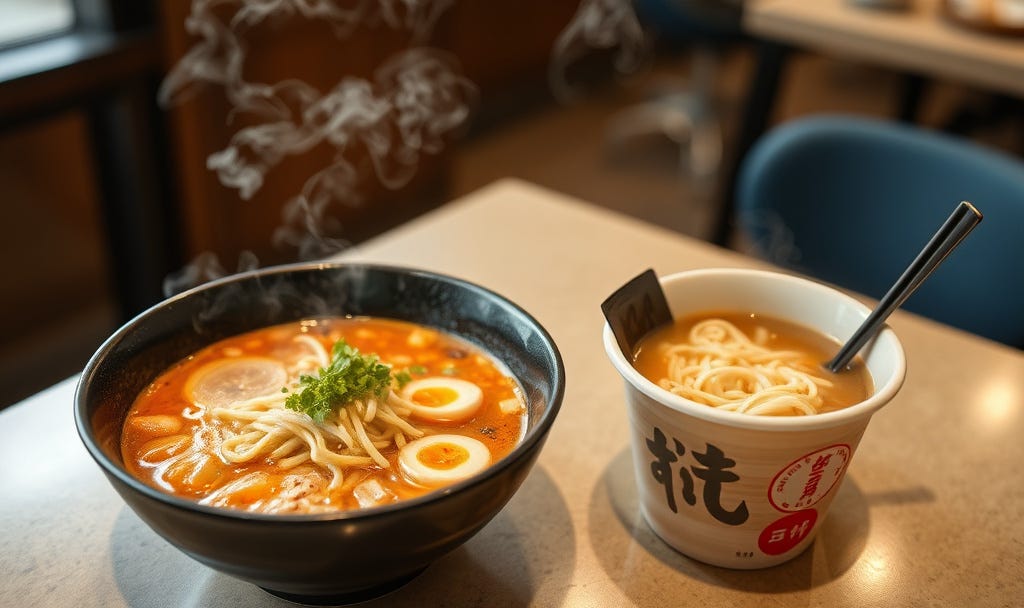
While researching different aspects of Japanese culture in preparation for my trip, I really enjoyed the television series Manpuku, which tells the story of the invention of instant noodles and the turbulent life of their creator, Momofuku Ando. (Fictionalised, but based on real events, it is a long and convoluted family saga, spanning over 150 episodes, before, during, and after WWII; the main character, Fukuko Imai, and her husband, Manpei, deal with all sorts of misfortunes and dramas, and the idea of instant noodles doesn’t even appear until episode 90. So if you are planning to watch it - be aware: it is not for the faint of heart. As a true Japanese story, it requires patience, dedication, and fortitude. However, it is also very optimistic and inspiring, and offers an insight into the way of life of ordinary Japanese people in the mid-twentieth century.)
So, what did I learn from watching all 151 episodes?
It turns out that something we think of as so deeply Japanese - ramen - wasn’t a traditional Japanese food at all, but an adopted Chinese noodle dish, introduced to Japan and gradually adjusted to Japanese tastes.
The history
Noodles have been part of Chinese food culture for centuries, and there is historical evidence of noodles being boiled and then fried before being served in a soup - a preparation resembling what later became known as Yi noodles. (For this reason, some early instant-noodle packaging was labelled ‘Yi noodles’.)
The Japanese ramen we know today, however, did not arrive in Japan as a finished Chinese dish. It developed gradually from Chinese-style wheat noodle soups brought to Japan in the late nineteenth and early twentieth centuries. Chinese communities in port cities such as Yokohama had restaurants and food stalls serving noodle dishes, so Japanese customers began eating them too. The famous Rairaiken restaurant in Asakusa, Tokyo, which opened in 1910, was also serving a Chinese noodle soup that became enormously popular.
Not only the recipe, but even the name of the new dish wasn’t Japanese for a long time. Even after ramen restaurants became common, they were not serving ‘ramen ’; the Chinese noodle soups were called Nankin soba, Shina soba, or later, chūka soba, literally “Chinese noodles” or “Chinese-style soba.” The word ramen is believed to have come from the Chinese lāmiàn, meaning noodles that are pulled or stretched, but there isn’t complete agreement on the etymology. Japanese reference sources explicitly describe the origin as uncertain. It wasn’t until the postwar period, and particularly after the launch of instant Chicken Ramen in 1958, that ‘ramen’ became the familiar national name for the dish.
Chinese noodle soups were also sold at street stalls, where the dish started changing and becoming Japanese. The postwar years accelerated this transformation. Japan was suffering from food shortages. Wheat, barley, and imported rice were brought in to supplement the food supply. The government increasingly substituted wheat for imported rice during the 1950s, partly because wheat imports were economically advantageous and partly because they were seen as a way of improving nutrition. Wheat flour became a staple of the Japanese diet.
The noodles were made with wheat flour and kansui, the alkaline water that gives ramen noodles their distinctive springy texture and yellowish colour. The broths and seasonings evolved too - soy sauce, salt, miso, pork, chicken, fish, and seafood - all found their way into different regional versions of the recipe.
Ramen was cheap, filling, nutritious, hot, and accessible, making it particularly attractive in a country struggling to recover from the war. It became increasingly popular, particularly among workers and urban populations. It was eaten out - at restaurants and at yatai, the portable food stalls that were a familiar sight on Japanese streets. The dish continued to evolve, acquiring Japanese characteristics; ramen stalls multiplied, and regional styles began to develop. Sapporo, Hakata, Tokyo, Osaka and countless other places eventually created their own versions. What had started as a signature Chinese-style dish gradually became something distinctly Japanese.
The recipe
A bowl of traditional Japanese ramen is essentially built from four components that can vary enormously by region and style. The formula is
Ramen = noodles + broth + tare + aromatic oil + toppings
Noodles are usually wheat noodles made from wheat flour, water, salt, and kansui, an alkaline solution that gives ramen noodles their characteristic springiness, chewiness, and slightly yellow colour.
Broth is the liquid base. It can be made from chicken, pork bones, fish, seafood, vegetables, or combinations of these. The broth can be clear and delicate or thick, rich and creamy.
Tare is the concentrated seasoning that gives the broth its main flavour. The three classic types are shoyu (soy sauce), shio (salt) and miso. The tare is usually added separately from the broth, which allows ramen shops to create different flavours from the same basic stock.
Aromatic oil - a small amount of flavoured oil added to the bowl for richness. Sesame oil, garlic oil, chicken fat, pork fat or chilli oil.
Toppings - these vary enormously, but the classics include chashu (braised pork), menma (fermented bamboo shoots), negi (spring onion), nori (dried seaweed), and ajitama (marinated soft-boiled egg).
Other additions - depending on the regional style, you might find corn, butter, bean sprouts, cabbage, mushrooms, spinach, fish cake, minced meat or other vegetables.
Amazing flavours, texture and taste. Anyone who has ever tried ramen would understand why it is one of the most loved Japanese dishes.
But the story of ramen doesn’t end here.
The revolution
It started with Momofuku Ando and his mind-blowing invention - instant ramen. A completely new concept that people couldn’t even understand at first. And they weren’t buying it, because no one had ever heard of cooking ramen at home and no one was willing to try. Everyone thought that it was crazy.
Instant noodles, or instant ramen, didn’t taste like the restaurant ramen. Their inventor started by studying the different recipes and techniques used by noodle sellers, but eventually he engineered an entirely new product and changed the taste and the flavour to fit the requirements of convenience, nutrition and accessibility.
Momofuku Ando's invention was revolutionary. It transformed noodle soups into a completely different kind of food - something that could be stored safely for months and prepared in only 3 minutes. You no longer needed a ramen shop, a noodle stall, a kitchen, or a skilled cook. You just needed a cup of boiling water. Suddenly, ramen stopped being something you had to buy freshly cooked and eat seated at the stall, and became something you could make almost anywhere and eat standing or even walking.
‘Chicken Ramen’ was formally launched by Nissin Foods in August 1958 (68 years ago) as the world’s first instant noodles - individually packed blocks of steamed and seasoned noodles, dehydrated by flash-frying, that could be prepared simply by adding hot water. Crazy or not, their convenience and taste proved irresistible, and instant noodles gradually became a huge part of Japanese food culture.
Instant ramen taking over the world
In the 1960s, instant noodles spread beyond Japan, and in 1971 Nissin introduced the world’s first Cup Noodles. The idea was inspired partly by Ando’s observations in the United States, where people broke up noodle blocks, put them into cups and poured boiling water over them. The cup itself became the packaging, the cooking vessel and the bowl. Another food revolution that swept the world. Today, instant noodles are a popular food in many parts of the world and are marketed under countless brand names, with flavours tailored to local tastes.
The word ‘ramen’ is used as a descriptor for instant noodle flavours by some Japanese manufacturers, but in the United States ‘ramen’ has become almost synonymous with instant noodles in general. The word has developed a confusing dual meaning - for the ramen dish cooked and served at Japanese restaurants, and for the instant noodle products.
In 2018, the World Instant Noodles Association (I know - I am also surprised such an organisation exists, but there you go.) reported that more than 103 billion servings were consumed worldwide. China and Hong Kong accounted for about 40 billion servings, while Indonesia consumed the very modest amount of about 12 billion. South Korea topped the world record in per-capita consumption, at around 75 servings, followed by Vietnam at about 54 and Nepal at 53. So it’s fair to say that ramen - and particularly instant ramen - has become one of the most widely consumed foods in the world.
What is actually in instant ramen?
Instant noodles are a very simple product. The basic ingredients are wheat flour, water and salt, with other ingredients added depending on the type of noodle - like palm oil, starches, seasoning, sodium phosphates and various gums. Ramen noodles also typically contain kansui. A separate seasoning sachet usually provides the characteristic flavour, and may contain salt, flavour enhancers, spices, dehydrated vegetables, soy protein or other ingredients. (Its development, using dry-freezing technology, was another food revolution by itself.)
Originally, instant noodles were flash-fried, which is still the dominant method used in Asia, but Western markets prefer air-dried noodles because of their lower fat content.
Nutritionally, instant noodles can’t offer much - they are primarily a source of carbohydrates and are generally high in sodium and fat. A single serving can contain well over half of the recommended daily sodium intake, but very little protein, fibre, vitamins or essential minerals.
So the appeal of instant ramen has never been that it is a good food. But it is cheap, portable, shelf-stable, filling and incredibly easy to prepare, which solved a real problem in the 1950s - how to make a hot meal available to almost anyone, almost anywhere, in almost no time among post-war food shortages when so many people were homeless or lived in poverty and not everyone had access to a real kitchen, or knew how to cook.
The idea of taking an existing Chinese tradition, adapting it, improving it, engineering it and turning it into something completely new is sooo Japanese - in fact, it is the most Japanese thing about ramen - not the recipe, or the ingredients, or even the noodles, but the creative internalisation and elevation of something that was originally foreign.
Izabela Shopova is a Bulgarian-Australian non-fiction writer, passionate traveler, nonlinear thinker, amateur artist, avid reader, learning designer, science lover, analog astronaut, mother and daughter, cat lady, fighter for democracy and for a better future. She has survived two emigrations, one divorce, and one teenager, has 3 passports, 7 published books and a tiny apartment in Brisbane, Australia, which she shares with Cricket the Garden Cat.
You can find her books on Amazon or check them out on Goodreads. and read excerpts here on Substack
Loved this.
Dried packages of instant noodles-quick and chea- was a college staple for many students!
We've had this at home years ago.
My wife made noodles- our small chromed noodle making machine with a hand crank is retired- but we still enjoy noodles around birthdays.
A tradition is if you don't cut the noodles, you will have long life.
Not sure where that one comes from.
Loved this read, Izabela.
Sounds like you have great patience to take in a slow-revealing film series!
Thanks, again.
I didn't know about ramens
For now, it's in London that i've eat the best japanese dish, with duck